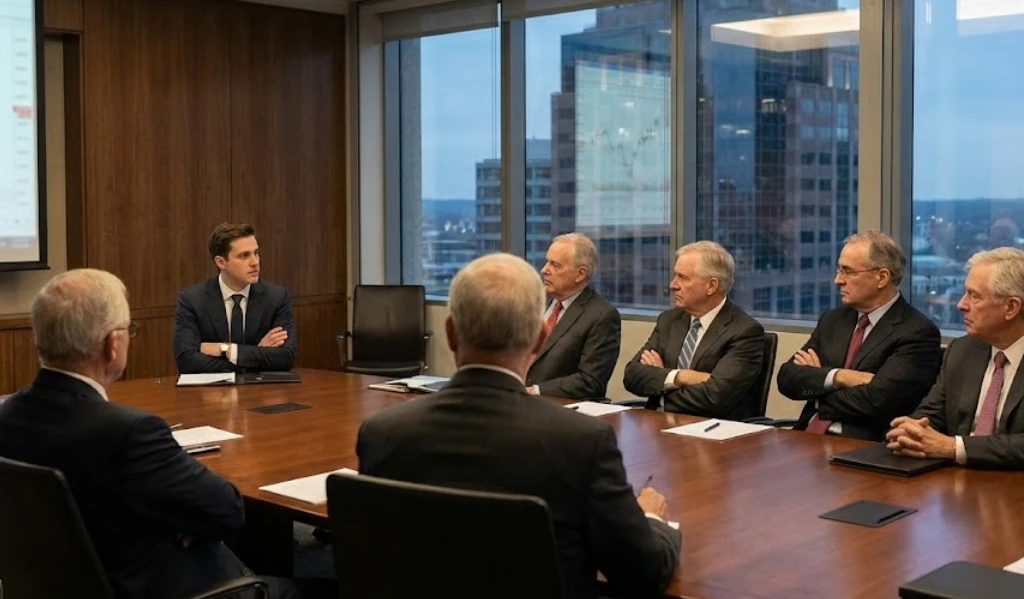
Key Highlights
- Reading the room is about sensing alignment, tension, and unspoken signals
- Senior leaders rely on observation as much as data
- Timing and tone often matter more than the content itself
- Informal cues reveal more than formal statements
- Strong leaders adapt in real time based on group dynamics
In high-stakes environments like boardrooms and executive meetings, decisions are rarely shaped by words alone. Beneath every discussion lies a layer of unspoken signals—hesitation, agreement, resistance, and influence. Senior leaders develop the ability to “read the room” not as a soft skill, but as a critical leadership capability.
This skill determines not just what decisions are made, but how and when they are made.
Beyond Words — Understanding the Unspoken Layer
At the CXO level, communication is rarely explicit. Leaders may agree publicly while holding private reservations. Others may stay silent—not out of agreement, but out of strategic restraint.
Reading the room involves noticing:
- Who speaks early versus who waits
- Changes in tone, pace, or confidence
- Body language—leaning in, withdrawing, or disengaging
- Patterns of interruption or silence
These signals often reveal more than the actual discussion.
Senior leaders learn that what is not said is often more important than what is.
Why Data Alone Is Not Enough
Most executives enter meetings well-prepared—with reports, dashboards, and analysis. However, data does not capture human dynamics.
Two leaders can present the same data—and receive very different responses.
The difference lies in:
- Perceived intent
- Trust levels in the room
- Timing of the discussion
- Existing alignment or tension
Reading the room allows leaders to interpret how their message is being received in real time, not just delivered.
The Role of Experience in Pattern Recognition
Senior leaders build this skill over time through repeated exposure to complex situations. They begin to recognise patterns:
- When silence signals disagreement
- When consensus forms too quickly
- When objections are softened or delayed
These patterns are rarely documented—but they are consistently observed.
Experienced leaders don’t react to individual moments—they interpret context.
Signals Leaders Pay Close Attention To
Some of the most telling indicators include:
- Side conversations after meetings
- Shifts in energy when specific topics arise
- Who supports whom—and when
- The difference between formal approval and real commitment
These cues help leaders distinguish between surface-level agreement and genuine alignment.
Timing — The Invisible Advantage
Knowing when to speak is often more important than what to say.
Leaders who read the room effectively:
- Wait until key stakeholders are engaged
- Avoid pushing decisions when resistance is building
- Introduce ideas when the room is most receptive
Poor timing can derail even the strongest proposals.
Good timing turns average ideas into accepted decisions.
Adapting in Real Time
Reading the room is not passive—it requires adjustment.
Senior leaders constantly recalibrate:
- Shifting tone from assertive to exploratory
- Asking questions instead of making statements
- Slowing down discussions when tension rises
- Bringing quieter voices into the conversation
This adaptability creates space for better decisions—and stronger alignment.
The Risk of Misreading the Room
Misinterpreting signals can have serious consequences:
- Assuming agreement where none exists
- Missing early signs of resistance
- Forcing decisions prematurely
- Damaging credibility through poor judgement
Leaders who rely only on formal communication often miss these risks.
What Strong Leaders Do Differently
Leaders who consistently read the room well tend to:
- Observe before they speak
- Listen for tone, not just content
- Validate alignment instead of assuming it
- Encourage open dialogue without forcing it
- Reflect after meetings to refine their understanding
They treat every interaction as a source of insight.
Reading the Room as a Leadership Discipline
This skill is not instinct alone—it can be developed.
Practical ways leaders improve include:
- Paying attention to reactions, not just responses
- Seeking feedback from trusted peers
- Reflecting on past decisions and outcomes
- Observing how experienced leaders navigate discussions
Over time, this builds sharper judgement and situational awareness.
Closing Reflection
At the senior level, leadership is as much about perception as it is about execution.
Reading the room is not manipulation—it is awareness.
It enables leaders to:
- Navigate complexity
- Build alignment
- Make better-timed decisions
In environments where influence matters as much as authority, those who understand the room shape the outcome.